


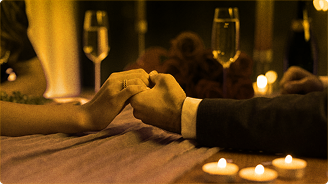
The Psychology of Play: Why Couples Who Laugh Together, Last Together
July 25, 2025
Trust is the only currency that matters in a relationship, yet it is a psychological anomaly. It takes years of consistent, boring, everyday actions to build, but it can be liquidated in a single thirty-second conversation. We often think of trust as a feeling, but it is actually a Predictive Model. When you trust someone, your brain has calculated the odds and decided that this person's future behavior will align with their past promises. You stop monitoring them. You lower your guard. You stop "calculating" and start "being." This mental relaxation is the highest form of human intimacy, but it is also the ultimate vulnerability.

Building trust isn't about the grand gestures. It's not about the expensive vacations or the public declarations of love. Instead, it's built through what psychologists call "Sliding Door Moments." Every day, we have hundreds of tiny opportunities to connect or turn away. When your partner sighs and looks out the window, you can ask what's wrong (turning toward) or keep scrolling through your phone (turning away). Trust is the accumulated "interest" from thousands of these tiny moments where you chose to prioritize the other person's reality. Each time you show up when you said you would, or listen when they are tired, you are laying a single brick. Over time, these bricks form a fortress.
The Psychology of Play: Why Couples Who Laugh Together, Last Together
July 25, 2025
The Romantic Blueprint: Why We Have a "Type" (And Why It's Usually Our Parents)
February 9, 2025
Green-Eyed Monsters: Why We Fear Losing What We Love
May 9, 2025
The problem is that our brains are biologically biased toward the negative. This is known as Negative Asymmetry. It takes dozens of positive interactions to outweigh a single negative one. In the context of trust, this means that a single lie doesn't just cancel out one truth; it casts a shadow over the entire history of the relationship. When trust is broken, the brain goes into a state of Cognitive Dissonance. You are forced to reconcile two incompatible versions of reality: the person you thought you knew and the person who just betrayed you. To resolve the pain, the brain often defaults to a "scorched earth" policy—it stops trusting everything that person ever said, even the true parts.
Once a betrayal occurs—whether it's infidelity, a financial secret, or a broken promise—the relationship enters a state of Relational Trauma. The betrayed partner's nervous system becomes hyper-vigilant. They begin "checking," "scanning," and "interrogating." This isn't because they are "crazy"; it's because their predictive model has crashed. They are trying to find a new "safe" baseline. For trust to be rebuilt, the "Bricks and Rubble" rule applies: you cannot just glue the old pieces back together. You have to clear the site and start laying bricks from scratch. This requires the betrayer to accept a period of total transparency and the betrayed to eventually risk the pain of trusting again. It is the hardest work two humans can do.
Perhaps the most important realization about the architecture of trust is that it requires Self-Trust as its foundation. If you don't trust your own judgment, or your own ability to survive a loss, you will always be a "policeman" in your relationship rather than a partner. You will try to control the other person to prevent them from hurting you. But control is not trust. True trust is the internal knowledge that even if the other person fails you—even if the fortress crumbles—you have the tools, the resilience, and the self-worth to build something new elsewhere. Ultimately, trust is a gamble on the unknown. There are no guarantees in the human heart. We lay our bricks every day, knowing that the structure could be destroyed by a single storm. But we build anyway. Because a life spent behind a wall of "perfect safety" is a life without the heat of real connection. The beauty of trust isn't that it is unbreakable; the beauty is that we choose to offer it at all, knowing the cost of the rubble.